


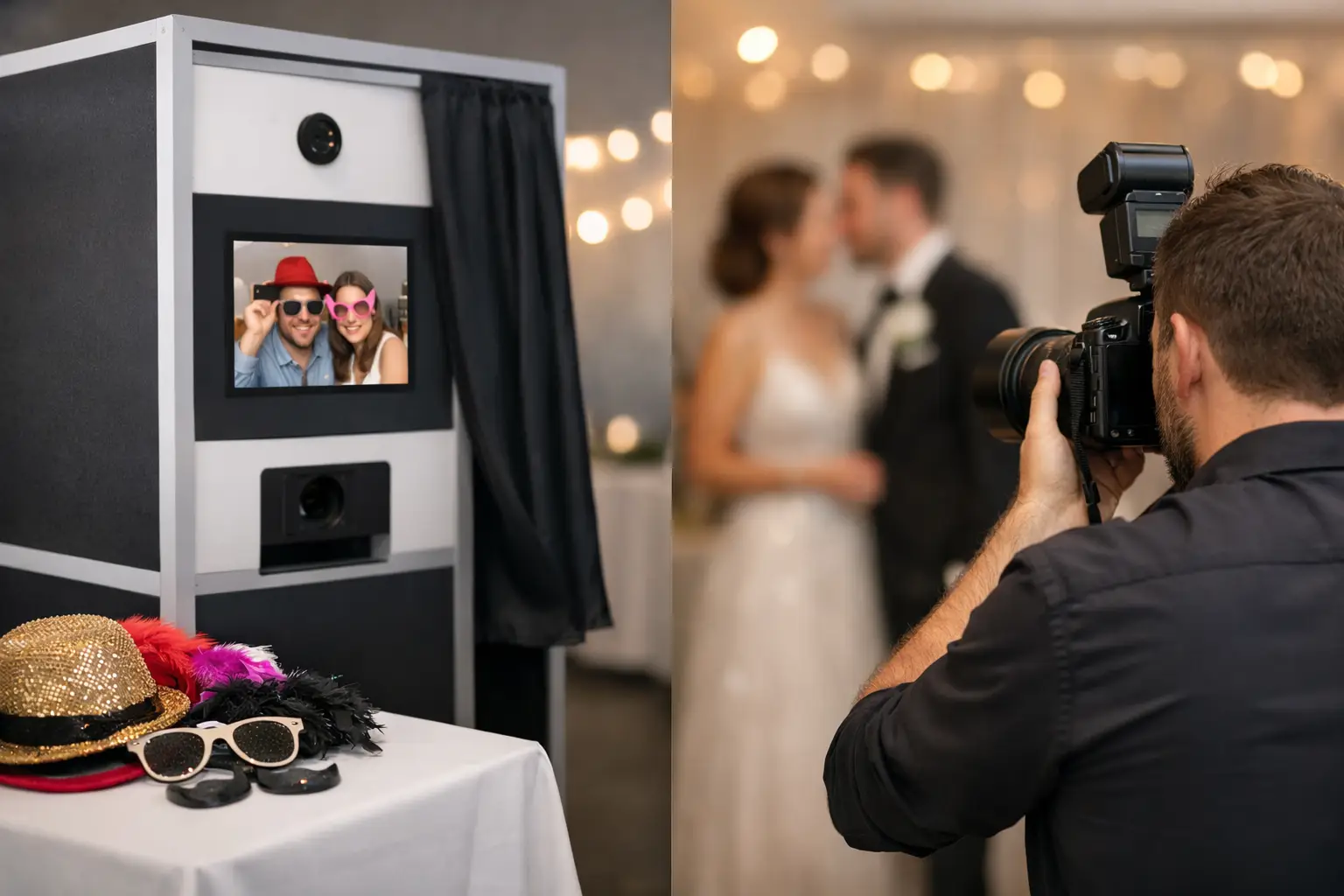
16 Aug Photo Booth Versus Photographer: Which Fits?
A keynote ends, the dance floor opens, or a product reveal lands – and suddenly everyone has a camera in hand. The question is not whether your event needs visual content. It is whether a photo booth versus photographer is the right choice for the experience you want guests to have and the images you need afterward.
They are often grouped together because both produce photos, but they serve distinctly different roles. A professional photographer documents the event as it unfolds. A photo booth invites guests to step into the experience, participate in it, and leave with a polished moment of their own. Choosing well starts with understanding the outcome each service is designed to create.
Photo Booth Versus Photographer: Different Jobs
An event photographer is there to observe, anticipate, and preserve. Their work captures the atmosphere of the room, executive remarks, meaningful reactions, décor details, sponsor visibility, milestone moments, and candid interactions that would otherwise pass quickly. Photography is essential when your priority is event storytelling.
A premium photo booth is guest-facing entertainment with a visual payoff. It gives attendees a reason to gather, pose, laugh, create, and share. Rather than documenting the room from the outside, it becomes part of the room’s energy. For a brand activation, gala, wedding, or employee celebration, that distinction matters.
The simplest way to frame the decision is this: a photographer tells the story of your event, while a photo booth gives guests a role in it.
What a photographer does best
Professional event photography is the stronger choice when the event has moments that cannot be recreated. Think leadership presentations, award recipients taking the stage, a ribbon cutting, a first dance, a guest speaker, or a carefully designed product moment. A skilled photographer knows where to stand, how to work with changing light, and when to capture a reaction before it disappears.
This coverage also creates a broad visual record. Corporate teams may need images for future marketing, internal recaps, media outreach, recruiting, or social channels. Couples and private hosts may want the full arc of the celebration, from quiet pre-event details to the final toast. Those images require an editorial eye and active direction behind the camera.
A photographer can also work beyond the obvious. Environmental portraits, sponsor moments, leadership interactions, and wide room shots help convey scale and purpose. For events where the guest list, program, or production design carries significance, this context is invaluable.
What a photo booth does best
A photo booth creates a destination. Guests do not need to wait for a candid moment or wonder whether they were photographed. They can walk up, interact with the experience, see themselves on screen, and receive polished imagery designed around the event.
That participation is especially powerful when the goal is engagement. At conferences, it can draw attendees away from passive foot traffic and into a sponsor experience. At brand events, it can turn a product message, campaign color palette, or custom backdrop into shareable content. At weddings and private celebrations, it gives every generation a low-pressure reason to join the fun.
Modern photo booth experiences can be far more distinctive than a basic backdrop and props. DSLR-quality imagery, customized templates, branded overlays, refined backdrops, GIFs, boomerangs, 360 video, and thoughtful lighting can make the installation feel like a natural extension of the event design. With a professional attendant managing the guest flow and details, the experience stays polished from first photo to final frame.
Choose Based on the Event Outcome
The best choice depends less on event size than on what success looks like. If you need proof that an event happened, photography is the foundation. If you need guests to actively engage with an event, a photo booth may deliver more immediate energy.
For a corporate conference, a photographer is often essential for capturing speakers, breakout sessions, networking, branded signage, and the scale of the program. A photo booth adds a different layer: it can create a memorable networking hub and supply attendees with branded content they are inclined to keep and share.
For a product launch or experiential campaign, the booth may take center stage. A custom visual activation can put the campaign directly into guests’ hands and create content at a pace traditional event coverage cannot match. Yet a photographer still has an important role in documenting the activation itself, including lines of engaged guests, the finished environment, and the high-level brand experience.
For weddings, the balance is equally clear. A photographer captures the ceremony, portraits, family moments, and candid scenes that become part of the couple’s permanent record. A booth gives guests their own keepsake and often captures a more playful side of the night. One protects the memory of the day; the other extends the celebration to everyone in the room.
When One Is Enough
There are events where choosing one service is entirely appropriate. A concise executive meeting, press announcement, intimate dinner, or formal awards presentation may benefit most from focused photography. The value lies in preserving the agenda, people, and atmosphere with discretion.
A booth can stand on its own for celebrations where the primary objective is guest entertainment. A birthday party, employee appreciation event, welcome reception, or casual holiday gathering may not require full documentary coverage, but it can benefit greatly from an interactive visual moment. In these cases, the booth becomes both activity and souvenir.
Consider the room dynamic as well. If guests will spend most of the event seated for a program, a photo booth provides an optional release point before or after the formal portion. If the event involves constant movement, multiple rooms, or a detailed schedule, a photographer is better equipped to follow the action wherever it goes.
Why the Strongest Events Often Use Both
For high-visibility events, the choice does not have to be either-or. A photographer and photo booth work exceptionally well together because they create different kinds of value without duplicating each other.
While the photographer captures the larger story, the booth gathers guest-created content in a controlled, on-brand setting. While the booth gives attendees a reason to interact, the photographer captures that interaction as evidence of a successful activation. The result is a more complete visual library: polished editorial images for the host or brand, plus lively, personal content for the people who attended.
This pairing is particularly effective for marketing teams and experiential agencies. The booth can carry campaign graphics, digital elements, and a carefully curated aesthetic. Photography can then document how the experience lived in the space, how guests responded, and how the activation supported the broader event environment. Those are two separate content needs, and both matter after the doors close.
At Pic Station, this approach is built around the idea that visual services should feel intentional, not added on. A booth installation can be designed as a high-end extension of the event, while professional photography and video preserve the larger experience with precision.
Questions to Ask Before You Decide
Before booking, clarify what you want guests and stakeholders to remember. Are you trying to capture a once-only moment, create a social-ready brand interaction, entertain a diverse guest list, or build a content library for future use? The answer will point you toward the right mix.
It also helps to consider timing. A photographer can cover an event from arrival through closing, adapting to the run of show. A photo booth performs best when it has a visible placement, enough guest traffic, and a schedule that gives people time to participate. For a short event, opening the booth during the busiest social window can have more impact than running it when guests are focused elsewhere.
Finally, think about visual alignment. A photographer’s style should reflect the tone of the event, whether that means editorial, candid, cinematic, or refined corporate coverage. A booth should look considered within the venue, not like an afterthought. Its backdrop, template, digital flow, and staffing should reinforce the level of the experience you have worked hard to produce.
The right visual partner does more than take pictures. They help make the moments worth capturing – then ensure your guests, your brand, and your event have something exceptional to show for it.